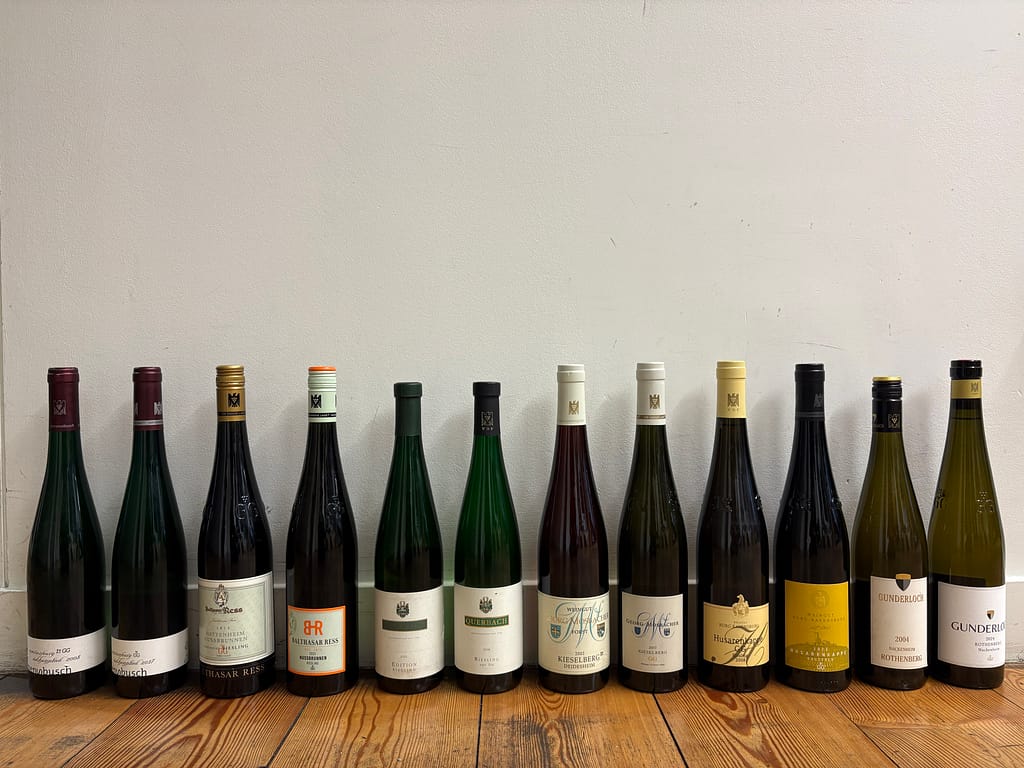
On the 21st September we hosted a tasting of the finest Rieslings from Germany, Alsace, Austria and Australia. The tasting, hosted by Anne Krebiehl MW, highlighted and reminded us that Riesling is fabulous and can demonstrate how wine can evolve and improve over time, often showing very different traits to their younger counterpart. Our in-house sommelier, Helga Schroeder MS, has kindly written up her tasting notes of these fabulous wines:
Dönnhoff Niederhäuser Hermannshöhle GG, 2015 and 2025
Precision and clarity are the words that come immediately to mind with Hermannshöhle GG. The 2015 retains extraordinarily pure fruit, carried by a lively, dancing acidity. There is something almost flirtatious about the wine: graceful and apparently effortless, yet with ample structure beneath to suggest a long future still ahead.
The 2025, the youngest wine of the entire tasting, is inevitably still very much in its primary-fruit phase. Yet the family resemblance to its older sibling is already apparent. If the 2015 offers any indication of the path ahead, there is a great deal to look forward to.
Clemens Busch’s Pündericher Marienburg Rothenpfad GG 2008 and 2017
From Devonian red slate and ungrafted vines planted before 1940, Rothenpfad produces a deeply serious, savoury expression of Riesling.
The 2008 is a deep, brilliant gold, just beginning to acquire caramel-toned hues. Wet stone and flint emerge first on the nose, followed by dried quince and marjoram. Rich yet subtle on the palate, it retains a wonderfully juicy texture, impressive length and a ripe, superbly integrated acidity. There seems little reason to doubt that it can continue happily for another decade.
The 2017, by comparison, is strikingly delicate, almost shy, and appears considerably younger than its nine years. There is a wonderful grace to it, but also a sense of latent energy, underpinned by more than 7 g/l of acidity. The potential for further development seems abundantly clear.
Gunderloch Nackenheimer Rothenberg GG 2004 and 2024
The 2004 is deep golden in colour, with expressive aromas of smoke, pine resin and dried orange peel. The palate is rich and savoury, with sage and ripe nectarine adding further layers. Yet despite this breadth and maturity, the wine remains crystalline and pure, with excellent length and density. It is a compelling example of how mature Riesling can gain amplitude without sacrificing definition.
Twenty years younger, the 2024 is a different creature altogether: full of unleashed temperament, vibrant acidity and abundant primary fruit. There is little attempt at serenity yet, but enormous promise for the future.
Karl Haidle Stettener Pulvermächer GG 2009 and 2019
The decade separating the wines also marks a generational change: the 2009 is made by Hans Haidle, the 2019 by his son Moritz, who takes over in 2014.
Both wines have more than 6 g/l acidity and are spontaneously fermented in neutral wooden casks, but the winemaking differs significantly. For the 2009, the grapes are crushed and given two hours of skin contact, followed by malolactic fermentation. The 2019 is whole-cluster pressed and does not undergo MLF. Residual sugar, too, shifts from just over 7 g/l in 2009 to only 3.5 g/l in 2019.
What remains constant is the foundation: fifty-year-old vines in a cool, steep vineyard on Schilfsandstein, giving wines of distinctly mineral, saline precision.
The 2009 is rich and savoury, with ripe grapefruit and marjoram, finishing with an insistent, tingling energy. The 2019 is livelier and more energetic, almost austere: a clear-cut, vertical wine filled with tension. If the older wine has acquired breadth and savour, the younger has the poise and tautness of a ballet dancer.
Domaine Weinbach Schlossberg Grand Cru 2010 and 2024
The 2010 is a highly sophisticated wine, seemingly just beginning to approach its peak. Deep gold with faint hazelnut hues, it offers butterscotch notes suggestive of malolactic fermentation alongside ripe, juicy red apple. On the palate it is exceptionally rich and soft, yet the acidity – a remarkable 9.8 g/l against 7 g/l residual sugar – is mouth-watering and persistent, carrying the wine into a dense, long and complex finish supported by subtle salinity and grip. A wonderful wine, and a persuasive reminder that richness and freshness need not be opposites.
The 2024 is already beautifully balanced, with density and length allied to a bone-dry structure of just 1 g/l residual sugar and notes of ripe nectarine. It may ultimately develop along a leaner line than the 2010, but it already possesses the stature – and the characteristic granite-driven drama – of Schlossberg GC.
Kilikanoon Mort’s Reserve Riesling 2012 and 2024
The 2012 is a textbook expression of Clare Valley Riesling. Golden straw in colour, it opens with waxy lime zest and lime cordial. The palate is extremely austere, focused, fresh and vertical – a wine that demands attention rather than courts it, packed with tension and structure. Bone dry and multilayered, it combines mature nuances with still-searing acidity to create a character all its own.
The 2024, by comparison, shows considerably more peach and green apple on the nose, yet beneath that youthful fruit lies the same austere, upright architecture. Few pairs in the tasting illustrate more clearly how dramatically Riesling can change while retaining its essential identity.
Georg Mosbacher Deidesheimer Kieselberg GG 2002 and 2017
The 2002 is deep golden in colour, with rich aromas of quince, lanolin, dried chamomile and hay. On the palate, notes of hayflower and thyme mingle with a creamy, generous texture. A lovely acidity, still remarkably fresh and lively, brings definition and lift to the dense, complex finish. There is a pleasing interplay between maturity and freshness, with the wine retaining considerable energy despite its age.
The 2017 appears considerably younger than its nine years, with a bright, pale straw colour and lively aromas of pomelo and ripe green apple. The palate is finely textured and well structured, with a beautifully integrated acidity providing freshness and balance. More restrained than the 2002, it nevertheless shows clarity and poise, with plenty of room for further development.
Balthasar Ress Hattenheimer Nussbrunnen GG 2013 and 2023
Both wines are balanced and accessible, although compared with the other wines in the tasting they lack somewhat in density and length.
The 2013 shows ripe tangerine and generous yellow peach, accompanied by distinctly bitter and sour notes that lend the wine an almost cidre amère-like character. There is richness to the fruit, but the contrasting bitter edge gives the wine a rather particular tension and savoury character.
The 2023 is more youthful in expression, with dried herbal notes of thyme alongside juicy green apple. A noticeable phenolic presence provides grip and structure, counterbalancing the fresh fruit and giving definition to the palate. While balanced and lively, it remains comparatively modest in depth and persistence.
Dr. Loosen Wehlener Sonnenuhr GG 2008 and 2020
Both wines are noticeably lacking in density, length and purity, not only in comparison with the other wines in the tasting but also in relation to what one might expect from a Grosses Gewächs. Neither vintage quite achieves the concentration or precision evident in the stronger wines of the line-up, leaving an impression of relative lightness and limited persistence.
Weingut Bründlmayer Zöbinger Heiligenstein Alte Reben 1.ÖTW 2007 and 2022
Both wines come from old vines planted in the 1940s and 1970s on the Permian sandstone of the south-facing Heiligenstein.
The 2007 opens with an almost perfumed nose of waxy orange peel, muscat, mace and cinnamon. There is lively acidity, but it is the fine tannic structure and grip that shape the wine most clearly. Textured and distinctly savoury, it has considerable presence, carrying its breadth with remarkable definition. A structured, captivating wine with an insistent, lingering finish.
The 2022 is beautifully balanced: finely tuned, nervy and full of tension. Orange-toned fruit appears again, joined by pomelo, giving the wine a vivid freshness. Dense and tightly composed, it already shows impressive poise, while the underlying structure suggests plenty of promise for the years ahead.
Schloss Gobelsburg Zöbinger Heiligenstein 1.ÖTW 2010 and 2019
Both wines come from the south-facing Permian sandstone slopes of the Heiligenstein, planted between the 1990s and 2000s at a density of around 5,500 vines per hectare. Residual sugar falls from 7.7 g/l in 2010 to 4.5 g/l in 2019.
The 2010 shows distinctly mature aromas of marshmallow, dried apricot and a touch of caramel. The palate moves into a more earthy, savoury register, with wet stone, mushroom, root vegetables and smoke adding considerable depth. This is a powerful, muscular wine, with a slightly elevated level of alcohol that is nevertheless very well absorbed by its substantial structure. Broad and firmly built, it has a compellingly savoury character and considerable presence.
Interestingly, the 2019 appears somewhat riper and more opulent than the 2010, remaining firmly on the ripe-fruited side of the spectrum. Yet there is excellent balance: a firm, grippy acidity provides a convincing counterpoint to the wine’s generous body and richness. Powerful and expansive, but held together by freshness and structure, it remains remarkably composed.